01
Which flowmeter is best for an industrial application?
There is no single best flowmeter. The correct technology depends on the fluid, flow range, pipe size, pressure, temperature, accuracy requirement and installation conditions.
Technical guidance on industrial flow measurement, flowmeter selection and applications for water, steam, gas, chemicals and compressed air across the UAE.
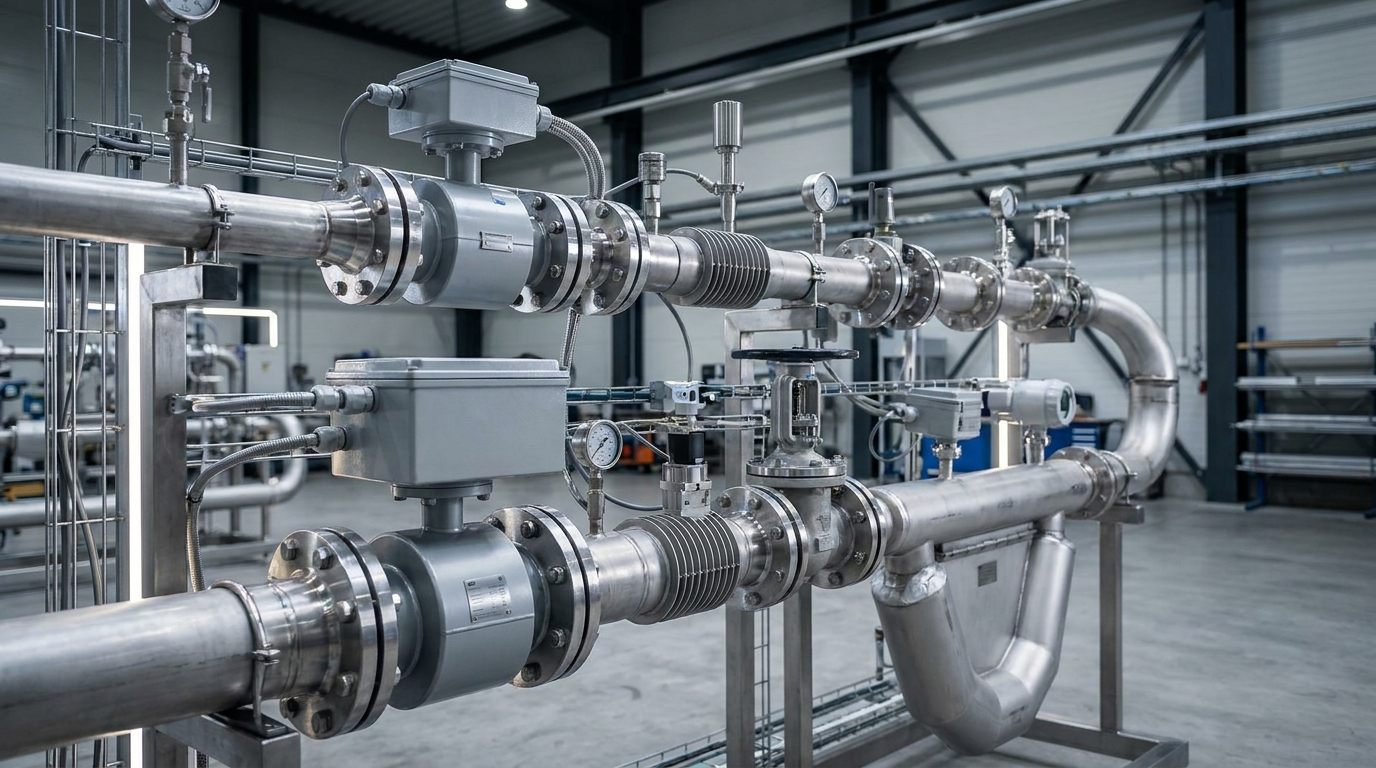
Reliable flow measurement starts with understanding the application, not simply selecting an instrument. Different liquids, gases and steam services require different measurement principles. Fluid properties, pipe size, operating pressure, temperature, required accuracy, flow range, installation conditions and maintenance requirements can all influence the correct choice.
SensCore supports industrial flow measurement applications with technologies for water, wastewater, chemicals, slurry, steam, compressed air, process gases and other industrial fluids.
Electromagnetic Flowmeters — Electromagnetic flowmeters measure the volumetric flow of conductive liquids using electromagnetic induction. They are widely considered for water, wastewater, conductive chemicals and slurry where the process medium is compatible with the liner and electrodes.
Vortex Flowmeters — Vortex flowmeters detect vortices generated as fluid passes a bluff body. They can be applied to liquids, gases and steam and are particularly relevant to steam, utility and industrial gas measurement.
Ultrasonic and Clamp-On Flowmeters — Ultrasonic instruments use acoustic signals to determine fluid velocity. Clamp-on designs can measure suitable liquids externally without cutting the pipeline, making them useful for surveys, verification and temporary measurement.
Coriolis Mass Flowmeters — Coriolis meters measure mass flow directly and can be considered where accurate mass measurement is important, subject to correct sizing, pressure drop and material compatibility.
Thermal Mass Flowmeters — Thermal mass meters measure gas mass flow using heat transfer principles and are particularly useful for compressed air and compatible industrial gases.
Differential Pressure and Pitot Tube Flowmeters — Differential pressure and insertion technologies can be useful for gases, steam, compressed air and larger pipelines where pressure loss and installation constraints must be considered.
Turbine, Variable Area and Other Flowmeters — Turbine, variable area, water meter, micro-flow and other specialised technologies can be considered where the application calls for a specific measurement range or operating arrangement.
Flowmeter selection should consider the complete operating condition.
Important factors include the measured medium, minimum and maximum flow, pipe diameter, pressure, temperature, density, viscosity, conductivity, solids content, required accuracy, available straight pipe length, connection type, material compatibility, hazardous area requirements, communication outputs and future maintenance access.
The best measurement technology is therefore application specific.
SensCore supports flow measurement requirements across water and wastewater systems, oil and gas facilities, chemical processing, manufacturing, power generation, food and beverage plants, utilities, compressed air networks, HVAC and district cooling systems.
Applications may include process flow control, utility metering, steam monitoring, compressed air consumption, water distribution, chemical transfer, energy analysis, cooling circuits and temporary flow surveys.
Based in the UAE, SensCore supports industrial flow measurement requirements across Abu Dhabi, Dubai, Sharjah, Ajman, Ras Al Khaimah (RAK), Fujairah and Umm Al Quwain (UAQ).
Support can include flowmeter selection, application review, onsite flow surveys, flowmeter verification, commissioning support and troubleshooting for existing measurement systems.
There is no single best flowmeter. The correct technology depends on the fluid, flow range, pipe size, pressure, temperature, accuracy requirement and installation conditions.
Electromagnetic flowmeters are widely considered for conductive water and wastewater. Ultrasonic technologies can also be appropriate where non-intrusive measurement is required.
Vortex and differential pressure technologies are commonly considered for steam. Final selection should account for steam condition, pressure, temperature, flow range and compensation requirements.
Yes. Clamp-on ultrasonic flowmeters can measure suitable liquids externally without modifying the pipe and are useful for surveys and verification.
Provide the fluid, pipe size, flow range, operating pressure, temperature, connection requirement and required output. Conductivity, viscosity, density and solids content may also be required.
SensCore can review your process conditions and help determine a suitable measurement principle, configuration and installation approach for industrial flow applications across the UAE.