01
What is the difference between a level transmitter and a level switch?
A transmitter provides continuous level information. A switch detects when material reaches a predefined point.
Technical guidance on industrial level measurement, level transmitters and level switches for tanks, liquids, solids and process applications across the UAE.
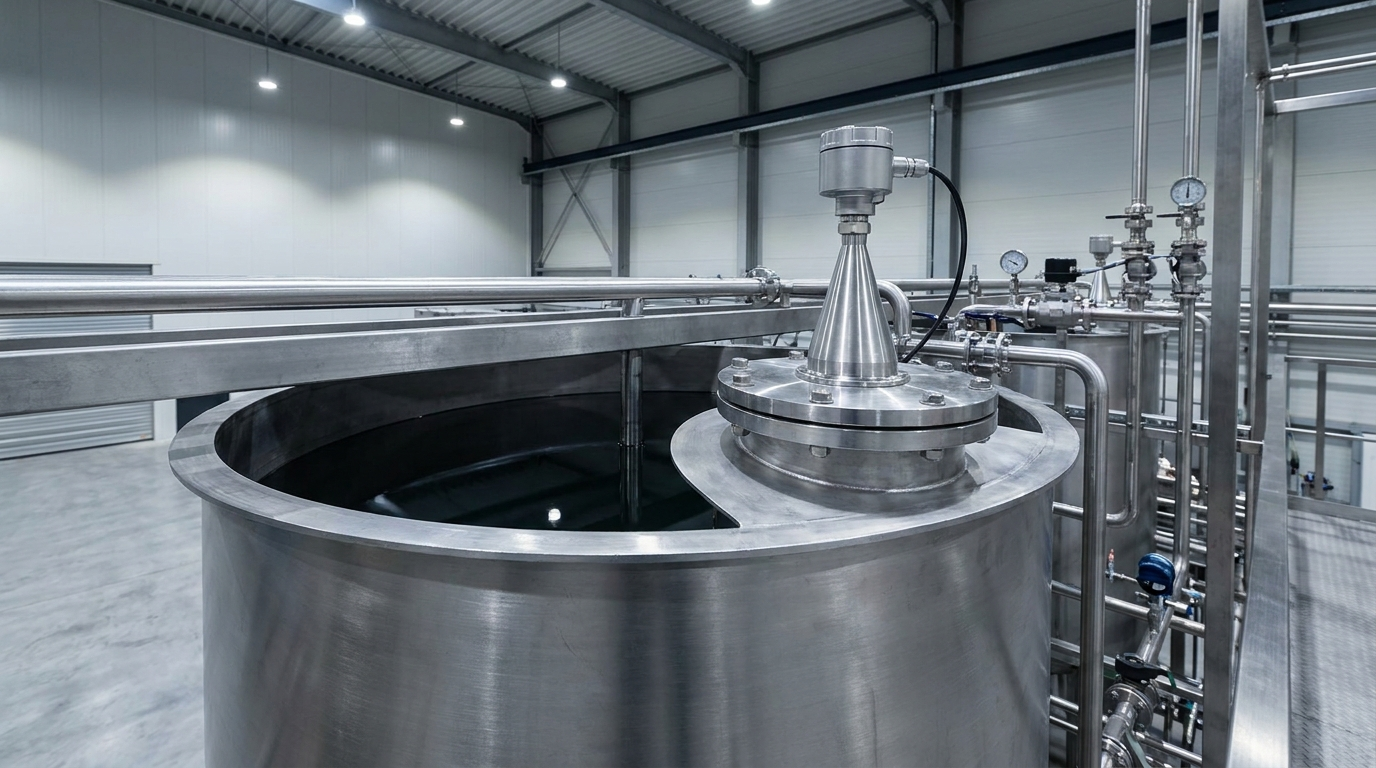
Reliable level measurement is essential for process control, inventory monitoring, overflow prevention, pump protection and safe plant operation. The correct technology depends on the measured medium, pressure, temperature, density, dielectric properties, foam, vapour, agitation, tank geometry, solids behaviour and required measurement type.
SensCore supports continuous level measurement and point level detection for liquids, slurry, powders and bulk solids across industrial applications.
Radar Level Transmitters — Radar uses microwave signals to measure the distance to the material surface. Non-contact radar is widely considered for storage tanks, process vessels, liquids, slurry and bulk material applications.
Guided Wave Radar — Guided wave radar sends pulses along a rod or cable probe and can provide continuous measurement for liquids, slurry and selected solids where a guided signal is beneficial.
Ultrasonic Level Transmitters — Ultrasonic instruments measure the returning sound echo and can provide practical non-contact measurement for water tanks, wastewater and other suitable applications. Foam, vapour, turbulence and obstructions should be evaluated.
Magnetostrictive Level Transmitters — Magnetostrictive technology uses a magnetic float and sensing element for precise continuous liquid level measurement in compatible tanks and process vessels.
Float Continuous Level Transmitters — Float-based transmitters mechanically follow liquid level and can provide a straightforward solution where the liquid and mechanical installation conditions are compatible.
Continuous measurement is not always required. Many processes only need confirmation that material has reached a defined high or low point.
Vibrating Level Switches — Tuning fork or vibrating switches detect changes when the sensing element contacts the process medium and are commonly used for alarms, overflow prevention and pump protection.
Float Level Switches — Float switches use buoyancy to detect a predefined liquid level and can support tank control, alarms and pump operation.
Rotary Level Switches — Rotary switches are commonly used for powders, granules and bulk solids in silos and hoppers.
Microwave and RF Level Switches — These technologies can be considered for demanding point-level applications involving liquids, slurry, powders or bulk materials where conventional switching may be unsuitable.
Level measurement should be selected around the complete process condition.
Measured liquid, slurry, powder or solid
Continuous measurement or point level detection
Tank height and geometry
Pressure and temperature
Density and dielectric properties
Foam, vapour, dust and agitation
Material build-up
Internal obstructions
Process connection
Wetted material compatibility
Required output and communication
Hazardous area requirements
Industrial level measurement is used across water and wastewater treatment, oil and gas, chemical processing, petrochemical facilities, manufacturing, food and beverage, utilities and bulk material handling.
Typical duties include storage tank monitoring, process vessel level control, water tank measurement, chemical tank monitoring, slurry level measurement, silo level detection, overflow alarms, dry-running protection and inventory monitoring.
SensCore supports industrial level measurement requirements across Abu Dhabi, Dubai, Sharjah, Ajman, Ras Al Khaimah (RAK), Fujairah and Umm Al Quwain (UAQ).
Our application-based approach considers the process medium, operating conditions, vessel configuration and control requirement before recommending a measurement principle.
A transmitter provides continuous level information. A switch detects when material reaches a predefined point.
Neither is universally better. Selection depends on the medium, vessel, measuring range, vapour, foam, temperature, pressure and surrounding conditions.
Yes. Non-contact radar measures the product surface from above the vessel without requiring an immersed probe.
Radar, guided wave radar, rotary switches, vibration switches and other technologies may be considered depending on material properties and whether continuous or point measurement is required.
Useful information includes the medium, vessel dimensions, measuring range, pressure, temperature, process connection, material compatibility and required measurement type.
SensCore can review the vessel, process medium and operating conditions to help determine a suitable level measurement principle and instrument configuration.