01
What is the difference between a pressure gauge and a pressure transmitter?
A pressure gauge normally provides local indication. A pressure transmitter converts measured pressure into a signal for a control or monitoring system.
Technical guidance on pressure and temperature measurement, transmitters, differential pressure, RTDs and thermocouples for industrial applications across the UAE.
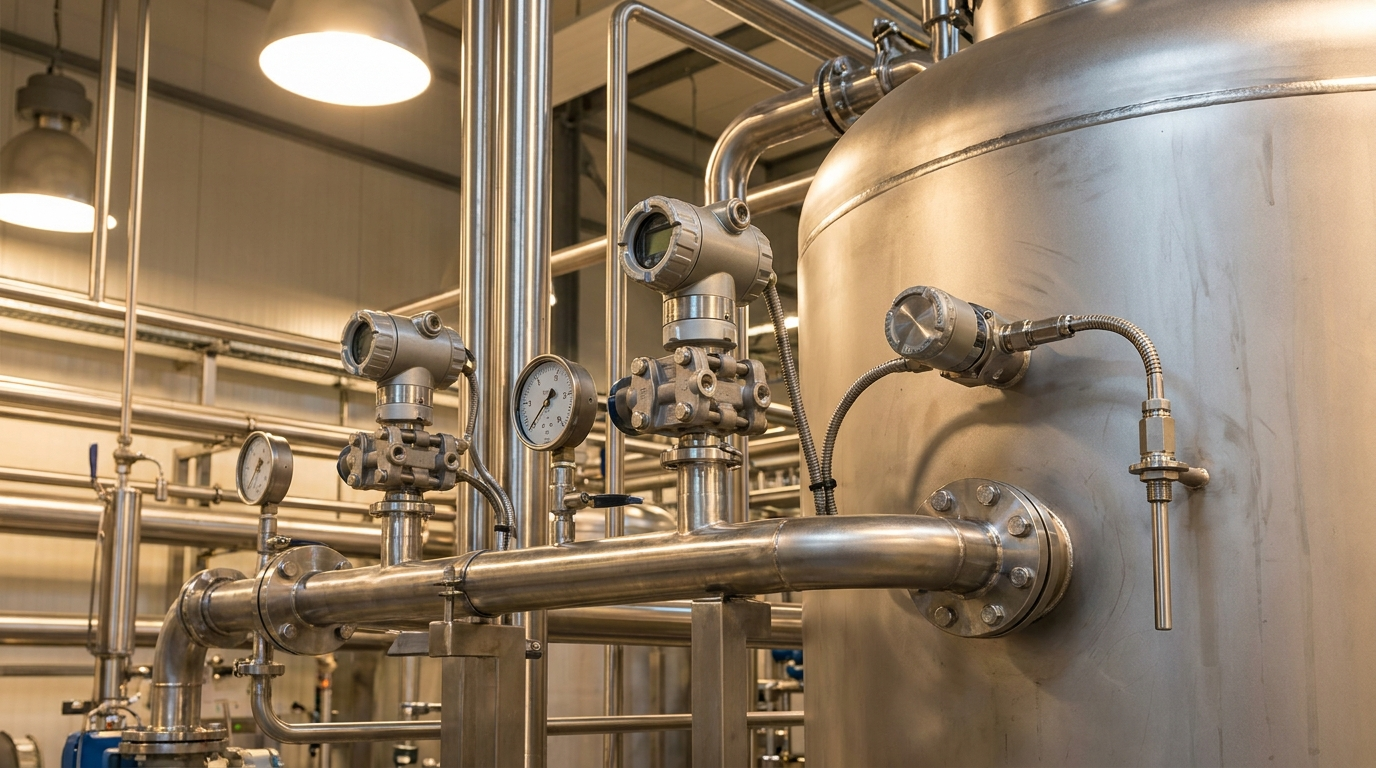
Pressure and temperature are fundamental process variables used to monitor equipment, control industrial processes, protect assets and maintain safe operating conditions. Reliable measurement depends on selecting the correct sensing technology, measuring range, process connection, wetted materials and installation arrangement.
Pressure measurement provides information about the force exerted by a liquid or gas within a process, pipeline, vessel or equipment system. Applications include pump discharge monitoring, compressed air networks, process pressure, filter condition, tank pressure and differential pressure.
Pressure transmitters convert process pressure into an electrical signal for a PLC, control system, indicator or monitoring platform. Selection should consider gauge or absolute reference, operating range, maximum pressure, process temperature, connection type and material compatibility.
Differential pressure transmitters measure the difference between two pressure points. They are widely used for flow measurement with primary elements and for filter, vessel and process monitoring. Range selection and impulse-line arrangement can directly affect measurement quality.
Pressure gauges provide local indication for equipment monitoring and maintenance checks. Pressure switches provide a discrete signal when pressure reaches a defined point and can be used for alarms, equipment protection and control functions.
Wireless pressure transmitters can provide an alternative where new signal cabling is difficult or costly. Selection should consider communication range, battery requirements, plant infrastructure and measurement criticality.
Temperature measurement is critical across heating, cooling, steam, chemical processing, utilities, machinery and manufacturing. The correct instrument depends on temperature range, accuracy, response time, process conditions and installation method.
Resistance Temperature Detectors use the predictable change in electrical resistance of a sensing element as temperature changes. RTDs such as Pt100 are widely applied where stable and accurate industrial temperature measurement is required.
Thermocouples generate a small electrical voltage related to temperature difference between joined dissimilar metals. They are commonly considered for higher-temperature applications and rugged sensing environments. Selection should consider temperature range, sheath material and response requirements.
Temperature transmitters convert RTD or thermocouple signals into standard industrial signals for PLCs, SCADA systems, indicators and control rooms. They may be integrated with a sensor or supplied separately.
Wireless temperature transmitters can support additional monitoring where conventional signal wiring is inconvenient. Communication reliability and application criticality should be evaluated before selection.
For pressure, consider pressure range, maximum allowable pressure, process medium, temperature, connection size, reference type and wetted materials. For temperature, consider operating range, accuracy, response time, sensor type, insertion length, thermowell requirement, process connection and environmental conditions. Signal requirements such as analogue output, HART, RS485 or wireless communication should also be considered.
Pressure and temperature measurements are important when other process variables depend on operating conditions. Steam and gas flow measurement may require pressure and temperature compensation because changes in process conditions affect density and calculated mass flow. Multivariable instruments can combine these measurements at a single measurement point.
Pressure and temperature instrumentation is widely used across oil and gas, water and wastewater, chemical processing, petrochemical plants, power generation, manufacturing, food and beverage, compressed air systems, HVAC, district cooling and utilities. Typical duties include pipelines, pumps, steam lines, heat exchangers, compressors, storage vessels, filters, boilers and cooling systems.
SensCore supports industrial pressure and temperature measurement requirements across Abu Dhabi, Dubai, Sharjah, Ajman, Ras Al Khaimah (RAK), Fujairah and Umm Al Quwain (UAQ). Our engineering approach considers the process medium, measurement range, operating conditions, installation requirements and control-system interface before recommending an instrument configuration.
A pressure gauge normally provides local indication. A pressure transmitter converts measured pressure into a signal for a control or monitoring system.
It measures the difference between two pressure points and can be used for flow measurement and filter condition monitoring.
Both measure temperature using different principles. RTDs are commonly selected where stability and accuracy are important, while thermocouples can be advantageous across wider and higher temperature ranges.
A transmitter converts the sensor output into a standard industrial signal that can be transmitted reliably to a PLC, indicator or control system.
Yes. Wireless transmitters can provide remote pressure or temperature data where suitable communication infrastructure is available.
SensCore can review your process conditions and help identify a suitable pressure or temperature measurement principle, instrument configuration and installation approach.